drawlib.graph
drawlib.graph provides five declarative graph layout solvers (ArchitectureGraph, LayerGraph, TreeGraph, RadialGraph, and GridGraph) that compute overlap-free node coordinates, nested container bounding boxes, and orthogonal or straight edge paths via get_layout(). Pair the returned GraphLayout geometry with drawlib.diagrams or drawlib.shapes and drawlib.lines in a clean two-step layout-and-render workflow.
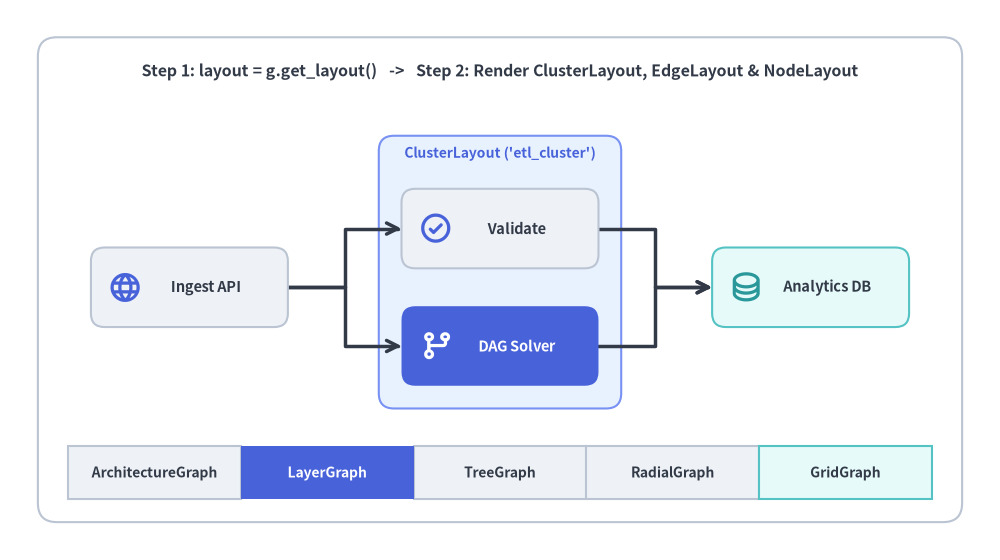
Two-Step Graph Layout Workflow: LayerGraph.get_layout() Solving Node, Cluster, and Edge Coordinates
Source Code
from drawlib.canvas import save , setup
from drawlib.graph import LayerGraph
from drawlib.icons import phosphor
from drawlib.lines import lines
from drawlib.shapes import rectangle
from drawlib.smartarts import BoxList
from drawlib.styles import Colors , Styles
from drawlib.text import text
setup ( width = 132 , height = 74 )
rectangle (
( 66 , 37 ),
width = 122 ,
height = 64 ,
style = Styles . Neutral . patch ( shape_fill_color = Colors . Transparent , line_style = "dashed" , shape_r = 2.5 ),
)
text (
( 66 , 64.5 ),
"Step 1: layout = g.get_layout() -> Step 2: Render ClusterLayout, EdgeLayout & NodeLayout" ,
style = Styles . DarkBold . patch ( text_size = 11.5 ),
)
g = LayerGraph ( direction = "LR" , rank_sep = 15.0 , node_sep = 5.0 , default_node_width = 26.0 , default_node_height = 10.5 )
g . node ( "ingest" )
g . node ( "validate" )
g . node ( "enrich" )
g . node ( "warehouse" )
g . tier ( "stage" , [ "validate" , "enrich" ], layer = 1 )
g . cluster ( "etl_cluster" , [ "validate" , "enrich" ], padding = 3.0 , header_height = 4.0 )
g . edge ( "ingest" , "validate" )
g . edge ( "ingest" , "enrich" )
g . edge ( "validate" , "warehouse" )
g . edge ( "enrich" , "warehouse" )
raw = g . get_layout ( width = 116 , height = 38 , margin = 2.0 )
cl = raw . clusters [ "etl_cluster" ]
dy = 38.0 - cl . cy
rectangle (
( cl . cx + 8.0 , cl . cy + dy ),
width = cl . width ,
height = cl . height ,
style = Styles . PrimaryNeutral . patch ( line_style = "dashed" , shape_r = 2.0 ),
)
text (
( cl . cx + 8.0 , cl . top + dy - 2.3 ),
"ClusterLayout ('etl_cluster')" ,
style = Styles . PrimaryBold . patch ( text_size = 10.0 ),
)
for edge in raw . edges :
pts = [( px + 8.0 , py + dy ) for px , py in edge . points ]
lines ( pts , arrow_head = "->" , style = Styles . DarkBold )
node_specs = [
( "ingest" , "Ingest API" , Styles . Neutral , Styles . DarkBold , Styles . PrimaryBold , phosphor . globe ),
( "validate" , "Validate" , Styles . Neutral , Styles . DarkBold , Styles . PrimaryBold , phosphor . check_circle ),
( "enrich" , "DAG Solver" , Styles . PrimaryFlat , Styles . WhiteBold , Styles . WhiteBold , phosphor . git_branch ),
( "warehouse" , "Analytics DB" , Styles . SecondaryNeutral , Styles . DarkBold , Styles . SecondaryBold , phosphor . database ),
]
for nid , label , card_st , txt_st , ico_st , icon_fn in node_specs :
n = raw . nodes [ nid ]
cx , cy = n . x + 8.0 , n . y + dy
rectangle (( cx , cy ), width = n . width , height = n . height , style = card_st . patch ( shape_r = 1.8 ))
icon_fn (( cx - 8.5 , cy ), width = 4.4 , style = ico_st )
text (( cx + 2.2 , cy ), label , style = txt_st . patch ( text_size = 10.5 ))
solvers = BoxList (
style = Styles . Neutral ,
text_style = Styles . DarkBold . patch ( text_size = 10.0 ),
)
solvers . add ( "ArchitectureGraph" )
solvers . add ( "LayerGraph" , style = Styles . PrimaryFlat , text_style = Styles . WhiteBold . patch ( text_size = 10.0 ))
solvers . add ( "TreeGraph" )
solvers . add ( "RadialGraph" )
solvers . add ( "GridGraph" , style = Styles . SecondaryNeutral )
solvers . draw ( xy = ( 9.0 , 8.0 ), box_width = 22.8 , box_height = 7.0 , direction = "left" )
save ()
class ArchitectureGraph Declarative 2-level macro/micro architecture graph layout solver. ArchitectureGraph arranges top-level architectural containers (VPCs, clusters, client zones, external SaaS boundaries) across compass zones or along the primary macro flow axis while automatically ordering internal services, subnets, and databases inside their respective boundaries.
from drawlib.graph import ArchitectureGraph
ArchitectureGraph (
* ,
direction : Literal [ "LR" , "TB" ] = "LR" ,
container_sep : float | None = None ,
edge_routing : Literal [ "orthogonal" , "straight" ] = "orthogonal" ,
default_node_width : float = 24.0 ,
default_node_height : float = 12.0 ,
) -> None
Parameter
Type
Default
Description
directionLiteral["LR", "TB"]"LR"Primary macro layout flow axis ("LR" left-to-right or "TB" top-to-bottom).
container_sepfloat | NoneNoneFixed spacing between top-level containers in canvas units; auto-scales when None.
edge_routingLiteral["orthogonal", "straight"]"orthogonal"Edge path routing strategy ("orthogonal" right-angle segments or "straight" direct ports).
default_node_widthfloat24.0Default width assigned to registered nodes when width is omitted.
default_node_heightfloat12.0Default height assigned to registered nodes when height is omitted.
Public Methods
Method
Signature
Returns
Description
node(id, *, width=None, height=None, ring=None, row=None, col=None, layer=None, group=None, subgroup=None)NodeRegister a node in the topology with optional group and subgroup container assignments.
edge(src, dst)EdgeRegister a directed connection from src to dst (auto-registers missing node IDs on solve).
cluster(id, nodes=None, *, padding=4.0, header_height=3.5, parent=None, order=None, pos=None)ClusterRegister a grouping boundary with optional parent nesting, sibling order, and 5-zone compass pos ("top", "bottom", "left", "right", "center").
group(id, *, nodes=None, padding=4.0, header_height=3.5, parent=None, order=None, pos=None)ClusterKeyword-only nodes alias for cluster() suited for VPCs, zones, and subnets.
get_layout(*, width=None, height=None, margin=10.0)GraphLayoutCompute compound macro/micro coordinates without rendering (defaults to active canvas size).
class BaseGraph Abstract base class inherited by all five declarative graph coordinate solvers (ArchitectureGraph, LayerGraph, TreeGraph, RadialGraph, and GridGraph). Provides shared node, edge, and cluster registration methods and the uniform get_layout() calculation interface.
from drawlib.graph import BaseGraph
BaseGraph (
* ,
default_node_width : float = 20.0 ,
default_node_height : float = 12.0 ,
) -> None
Parameter
Type
Default
Description
default_node_widthfloat20.0Fallback node width in canvas units when width is not passed to node().
default_node_heightfloat12.0Fallback node height in canvas units when height is not passed to node().
Public Methods
Method
Signature
Returns
Description
node(id, *, width=None, height=None, ring=None, row=None, col=None, layer=None, group=None, subgroup=None)NodeRegister a node in the graph topology.
edge(src, dst)EdgeRegister a directed connection between two node IDs.
cluster(id, nodes=None, *, padding=4.0, header_height=3.5, parent=None, order=None, pos=None)ClusterRegister a grouping boundary surrounding a subset of nodes.
group(id, *, nodes=None, padding=4.0, header_height=3.5, parent=None, order=None, pos=None)ClusterRegister an architectural container or group boundary.
get_layout(*, width=None, height=None, margin=10.0)GraphLayoutCompute node, edge, and cluster geometries without drawing onto the canvas.
class Cluster Dataclass representing a user-registered grouping boundary returned by g.cluster() or g.group().
from drawlib.graph import Cluster
Cluster (
id : str ,
nodes : list [ str ] = ... ,
padding : float = 4.0 ,
header_height : float = 3.5 ,
parent : str | None = None ,
order : int | None = None ,
pos : Literal [ "top" , "bottom" , "left" , "right" , "center" ] | None = None ,
) -> None
Attribute
Type
Default
Description
idstr(required) Unique cluster or container identifier.
nodeslist[str][]Member node IDs enclosed directly within this boundary.
paddingfloat4.0Inner clearance margin around enclosed nodes and child clusters.
header_heightfloat3.5Extra top clearance reserved for a container title banner.
parentstr | NoneNoneOptional parent cluster ID for nested hierarchies (e.g., subnet inside VPC).
orderint | NoneNoneExplicit ordering index among sibling containers.
posLiteral["top", "bottom", "left", "right", "center"] | NoneNoneMacro compass zone placement hint used by ArchitectureGraph.
class ClusterLayout Calculated bounding box and hierarchy coordinates for a solved cluster container in GraphLayout.clusters. Provides both bottom-left corners (for ArchitectureDiagram NodeGroup) and center coordinates (for primitive shapes).
from drawlib.graph import ClusterLayout
ClusterLayout (
id : str ,
bbox : tuple [ float , float , float , float ],
parent_id : str | None = None ,
local_bottom_left : tuple [ float , float ] = ( 0.0 , 0.0 ),
) -> None
Field
Type
Default
Description
idstr(required) Cluster identifier matching the registered Cluster.id.
bboxtuple[float, float, float, float](required) Global bounding box tuple (left, bottom, right, top) in canvas coordinates.
parent_idstr | NoneNoneParent cluster ID when nested inside an outer container, or None for top-level clusters.
local_bottom_lefttuple[float, float](0.0, 0.0)Bottom-left (x, y) relative to the parent cluster's bottom-left origin.
Properties
Property
Type
Description
bottomfloatBottom edge Y coordinate (bbox[1]).
bottom_lefttuple[float, float]Global bottom-left (left, bottom) coordinate (pass to top-level NodeGroup).
centertuple[float, float]Global cluster center (cx, cy) coordinate.
cxfloatGlobal cluster center X coordinate.
cyfloatGlobal cluster center Y coordinate.
heightfloatTotal cluster height (top - bottom).
leftfloatLeft edge X coordinate (bbox[0]).
rightfloatRight edge X coordinate (bbox[2]).
sizetuple[float, float]Cluster (width, height) dimensions.
topfloatTop edge Y coordinate (bbox[3]).
widthfloatTotal cluster width (right - left).
xytuple[float, float]Alias for center ((cx, cy)), suited for center-anchored rectangle().
class Edge Dataclass representing a directed topological connection between two nodes returned by g.edge(src, dst).
from drawlib.graph import Edge
Edge (
src : str ,
dst : str ,
) -> None
Attribute
Type
Default
Description
srcstr(required) Source node ID where the directed edge originates.
dststr(required) Destination node ID where the directed edge terminates.
class EdgeLayout Calculated port coordinates and intermediate routing waypoints for a solved edge in GraphLayout.edges.
from drawlib.graph import EdgeLayout
EdgeLayout (
src : str ,
dst : str ,
src_port : tuple [ float , float ],
dst_port : tuple [ float , float ],
waypoints : list [ tuple [ float , float ]] = ... ,
) -> None
Field
Type
Default
Description
srcstr(required) Source node identifier.
dststr(required) Destination node identifier.
src_porttuple[float, float](required) Boundary attachment point (x, y) on the source node perimeter.
dst_porttuple[float, float](required) Boundary attachment point (x, y) on the destination node perimeter.
waypointslist[tuple[float, float]][]Intermediate bend points (x, y) between src_port and dst_port.
Properties
Property
Type
Description
pointslist[tuple[float, float]]Complete polyline sequence [src_port, *waypoints, dst_port] ready for lines(edge.points, arrow_head="->").
mid_xytuple[float, float]Geometric midpoint (mx, my) along the routed path for placing edge labels.
class GraphLayout Complete geometrical result returned by get_layout() on any graph solver. Supports dictionary-style layout[key] lookup across both nodes and clusters, human-readable coordinate dumps via print(layout), and post-solve node nudging via .offset().
from drawlib.graph import GraphLayout
GraphLayout (
nodes : dict [ str , NodeLayout ] = ... ,
edges : list [ EdgeLayout ] = ... ,
clusters : dict [ str , ClusterLayout ] = ... ,
width : float = 100.0 ,
height : float = 100.0 ,
ring_radii : dict [ int , float ] = ... ,
) -> None
Field
Type
Default
Description
nodesdict[str, NodeLayout]{}Mapping from node ID to solved NodeLayout
edgeslist[EdgeLayout][]Ordered list of solved EdgeLayout
clustersdict[str, ClusterLayout]{}Mapping from cluster ID to solved ClusterLayout
widthfloat100.0Target layout width in canvas units.
heightfloat100.0Target layout height in canvas units.
ring_radiidict[int, float]{}Concentric ring index-to-radius mapping populated by RadialGraph
Public Methods
Method
Signature
Returns
Description
offset(node_id: str, dx: float = 0.0, dy: float = 0.0)SelfShift nodes[node_id] by (dx, dy) (updating .xy, .local_xy, and incident edge ports) and return self for chaining.
class GridGraph Declarative 2D matrix grid graph layout solver. Tiles nodes into regular rows and columns with configurable ordering ("row-major" or "column-major"), explicit (row, col) cell pinning, and inter-cell channel routing.
from drawlib.graph import GridGraph
GridGraph (
columns : int = 3 ,
* ,
rows : int | None = None ,
order : Literal [ "row-major" , "column-major" ] = "row-major" ,
col_sep : float | None = None ,
row_sep : float | None = None ,
edge_routing : Literal [ "smart" , "orthogonal" , "straight" ] = "smart" ,
default_node_width : float = 20.0 ,
default_node_height : float = 12.0 ,
) -> None
Parameter
Type
Default
Description
columnsint3Number of grid columns (>= 1).
rowsint | NoneNoneOptional explicit row count (computed automatically from node count when None).
orderLiteral["row-major", "column-major"]"row-major"Automatic slot filling order for unpinned nodes.
col_sepfloat | NoneNoneFixed horizontal gap between columns; auto-scales to canvas width when None.
row_sepfloat | NoneNoneFixed vertical gap between rows; auto-scales to canvas height when None.
edge_routingLiteral["smart", "orthogonal", "straight"]"smart"Edge routing mode ("smart" routes non-adjacent links cleanly through grid channels).
default_node_widthfloat20.0Default cell node width in canvas units.
default_node_heightfloat12.0Default cell node height in canvas units.
Public Methods
Method
Signature
Returns
Description
cell(cell_id, row=None, col=None, *, width=None, height=None)NodeConvenience helper to register a grid cell node at an optional 0-based (row, col) slot.
cluster_row(row, cluster_id, *, padding=4.0, header_height=3.5)ClusterGroup all nodes placed in 0-based row into a single cluster boundary.
cluster_column(col, cluster_id, *, padding=4.0, header_height=3.5)ClusterGroup all nodes placed in 0-based col into a single cluster boundary.
node(id, *, width=None, height=None, ring=None, row=None, col=None, layer=None, group=None, subgroup=None)NodeRegister a node in the matrix topology.
edge(src, dst)EdgeRegister a connection between two grid nodes.
cluster(id, nodes=None, *, padding=4.0, header_height=3.5, parent=None, order=None, pos=None)ClusterRegister a custom cluster surrounding arbitrary grid cells.
group(id, *, nodes=None, padding=4.0, header_height=3.5, parent=None, order=None, pos=None)ClusterKeyword-only nodes alias for cluster().
get_layout(*, width=None, height=None, margin=10.0)GraphLayoutCompute matrix grid coordinates and routed edge paths without rendering.
class LayerGraph Declarative Sugiyama-style layered hierarchical DAG layout solver (cycle breaking, longest-path rank assignment, and barycenter edge-crossing minimization). Ideal for CI/CD pipelines, ETL/Airflow data lineage, task DAGs, and module dependency graphs.
from drawlib.graph import LayerGraph
LayerGraph (
* ,
direction : Literal [ "LR" , "TB" ] = "LR" ,
rank_sep : float | None = None ,
node_sep : float | None = None ,
edge_routing : Literal [ "orthogonal" , "straight" ] = "orthogonal" ,
default_node_width : float = 22.0 ,
default_node_height : float = 12.0 ,
) -> None
Parameter
Type
Default
Description
directionLiteral["LR", "TB"]"LR"Rank progression axis ("LR" left-to-right or "TB" top-to-bottom).
rank_sepfloat | NoneNoneFixed spacing between consecutive ranks/layers; auto-scales when None.
node_sepfloat | NoneNoneFixed spacing between sibling nodes within the same rank; auto-scales when None.
edge_routingLiteral["orthogonal", "straight"]"orthogonal"Edge path routing mode ("orthogonal" Manhattan segments or "straight" direct ports).
default_node_widthfloat22.0Default node width in canvas units.
default_node_heightfloat12.0Default node height in canvas units.
Public Methods
Method
Signature
Returns
Description
tier(name, nodes, *, layer=None)NoneExplicitly pin multiple node IDs to the same layer/rank index (0, 1, ...).
node(id, *, width=None, height=None, ring=None, row=None, col=None, layer=None, group=None, subgroup=None)NodeRegister a node with an optional explicit layer rank.
edge(src, dst)EdgeRegister a directed dependency edge from src to dst.
cluster(id, nodes=None, *, padding=4.0, header_height=3.5, parent=None, order=None, pos=None)ClusterRegister a stage boundary surrounding a subset of nodes.
group(id, *, nodes=None, padding=4.0, header_height=3.5, parent=None, order=None, pos=None)ClusterKeyword-only nodes alias for cluster().
get_layout(*, width=None, height=None, margin=10.0)GraphLayoutCompute hierarchical layered coordinates without rendering.
class Node Dataclass representing a user-registered node in a graph topology returned by g.node(), g.cell(), g.spoke(), or g.child().
from drawlib.graph import Node
Node (
id : str ,
width : float | None = None ,
height : float | None = None ,
ring : int | None = None ,
row : int | None = None ,
col : int | None = None ,
layer : int | None = None ,
group : str | None = None ,
subgroup : str | None = None ,
) -> None
Attribute
Type
Default
Description
idstr(required) Unique node identifier string.
widthfloat | NoneNoneNode width override (None inherits solver's default_node_width).
heightfloat | NoneNoneNode height override (None inherits solver's default_node_height).
ringint | NoneNoneConcentric ring index for RadialGraph (0 = central hub).
rowint | NoneNoneExplicit 0-based row index for GridGraph.
colint | NoneNoneExplicit 0-based column index for GridGraph.
layerint | NoneNoneExplicit 0-based rank/layer index for LayerGraph.
groupstr | NoneNoneTop-level container ID for ArchitectureGraph.
subgroupstr | NoneNoneNested child container ID inside group for ArchitectureGraph.
class NodeLayout Calculated global and cluster-relative coordinates and dimensions for a solved node in GraphLayout.nodes.
from drawlib.graph import NodeLayout
NodeLayout (
id : str ,
xy : tuple [ float , float ],
width : float ,
height : float ,
parent_id : str | None = None ,
local_xy : tuple [ float , float ] = ( 0.0 , 0.0 ),
) -> None
Field
Type
Default
Description
idstr(required) Node identifier matching Node.id.
xytuple[float, float](required) Global center (cx, cy) coordinate on the canvas.
widthfloat(required) Solved node width in canvas units.
heightfloat(required) Solved node height in canvas units.
parent_idstr | NoneNoneEnclosing cluster ID when the node belongs to a cluster, else None.
local_xytuple[float, float](0.0, 0.0)Center (cx, cy) relative to the enclosing cluster's bottom_left origin (for NodeGroup.add()).
Properties
Property
Type
Description
bottomfloatBottom edge Y coordinate (y - height / 2).
bottom_lefttuple[float, float]Global bottom-left (left, bottom) corner coordinate.
centertuple[float, float]Alias for xy ((x, y) global center).
leftfloatLeft edge X coordinate (x - width / 2).
local_bottom_lefttuple[float, float]Bottom-left corner relative to the parent cluster's bottom_left origin.
rightfloatRight edge X coordinate (x + width / 2).
sizetuple[float, float]Node dimensions (width, height).
topfloatTop edge Y coordinate (y + height / 2).
xfloatGlobal center X coordinate (xy[0]).
yfloatGlobal center Y coordinate (xy[1]).
class RadialGraph Declarative radial and concentric-ring graph layout solver. Places a central hub node at center and distributes connected spoke nodes across concentric orbital rings with even angular spacing (GraphLayout.ring_radii exposes each ring's radius for drawing background orbit circles).
from drawlib.graph import RadialGraph
RadialGraph (
hub : str | None = None ,
* ,
center : tuple [ float , float ] | None = None ,
radius_step : float | None = None ,
start_angle : float = 0.0 ,
angle_range : float = 360.0 ,
default_node_width : float = 20.0 ,
default_node_height : float = 12.0 ,
) -> None
Parameter
Type
Default
Description
hubstr | NoneNoneOptional central hub node ID placed at ring 0 (inferred from topology if None).
centertuple[float, float] | NoneNoneExplicit (cx, cy) hub center coordinate; defaults to canvas center when None.
radius_stepfloat | NoneNoneRadial distance increment per concentric ring; auto-scales to fit canvas when None.
start_anglefloat0.0Starting angle in degrees (0.0 = +X axis, counter-clockwise).
angle_rangefloat360.0Total angular sweep in degrees (360.0 full circle, 180.0 fan/semicircle).
default_node_widthfloat20.0Default node width in canvas units.
default_node_heightfloat12.0Default node height in canvas units.
Public Methods
Method
Signature
Returns
Description
spoke(parent, spoke_id, *, ring=None, width=None, height=None)NodeConvenience helper that registers spoke_id (optionally on ring) and connects an edge from parent.
node(id, *, width=None, height=None, ring=None, row=None, col=None, layer=None, group=None, subgroup=None)NodeRegister a node with an optional concentric ring index.
edge(src, dst)EdgeRegister a radial or cross-spoke connection.
cluster(id, nodes=None, *, padding=4.0, header_height=3.5, parent=None, order=None, pos=None)ClusterRegister a grouping boundary around a subset of nodes.
group(id, *, nodes=None, padding=4.0, header_height=3.5, parent=None, order=None, pos=None)ClusterKeyword-only nodes alias for cluster().
get_layout(*, width=None, height=None, margin=10.0)GraphLayoutCompute radial node coordinates, edge ports, and ring_radii without rendering.
class TreeGraph Declarative tree layout solver using the Reingold-Tilford / Buchheim compact tree algorithm. Centers parent nodes cleanly above ("TB") or beside ("LR") their child subtrees without horizontal or vertical subtree overlap.
from drawlib.graph import TreeGraph
TreeGraph (
* ,
root : str | None = None ,
direction : Literal [ "TB" , "LR" ] = "TB" ,
level_sep : float | None = None ,
sibling_sep : float | None = None ,
default_node_width : float = 22.0 ,
default_node_height : float = 12.0 ,
edge_routing : Literal [ "orthogonal" , "straight" ] = "orthogonal" ,
) -> None
Parameter
Type
Default
Description
rootstr | NoneNoneExplicit root node ID (auto-detected from zero-indegree node when None).
directionLiteral["TB", "LR"]"TB"Tree expansion direction ("TB" top-to-bottom or "LR" left-to-right).
level_sepfloat | NoneNoneFixed distance between tree depth levels; auto-scales when None.
sibling_sepfloat | NoneNoneMinimum gap between adjacent sibling nodes/subtrees; auto-scales when None.
default_node_widthfloat22.0Default node width in canvas units.
default_node_heightfloat12.0Default node height in canvas units.
edge_routingLiteral["orthogonal", "straight"]"orthogonal"Parent-to-child connector routing style ("orthogonal" elbow fork or "straight").
Public Methods
Method
Signature
Returns
Description
child(parent, child_id, *, width=None, height=None)NodeConvenience helper that registers child_id (and parent if needed) and adds edge parent -> child_id.
node(id, *, width=None, height=None, ring=None, row=None, col=None, layer=None, group=None, subgroup=None)NodeRegister a tree node.
edge(src, dst)EdgeRegister a parent-to-child tree edge.
cluster(id, nodes=None, *, padding=4.0, header_height=3.5, parent=None, order=None, pos=None)ClusterRegister a subtree or level grouping boundary.
group(id, *, nodes=None, padding=4.0, header_height=3.5, parent=None, order=None, pos=None)ClusterKeyword-only nodes alias for cluster().
get_layout(*, width=None, height=None, margin=10.0)GraphLayoutCompute tidy tree coordinates and routed connectors without rendering.