ClassDiagram: UML 2.0 Class Hierarchies & Relationships
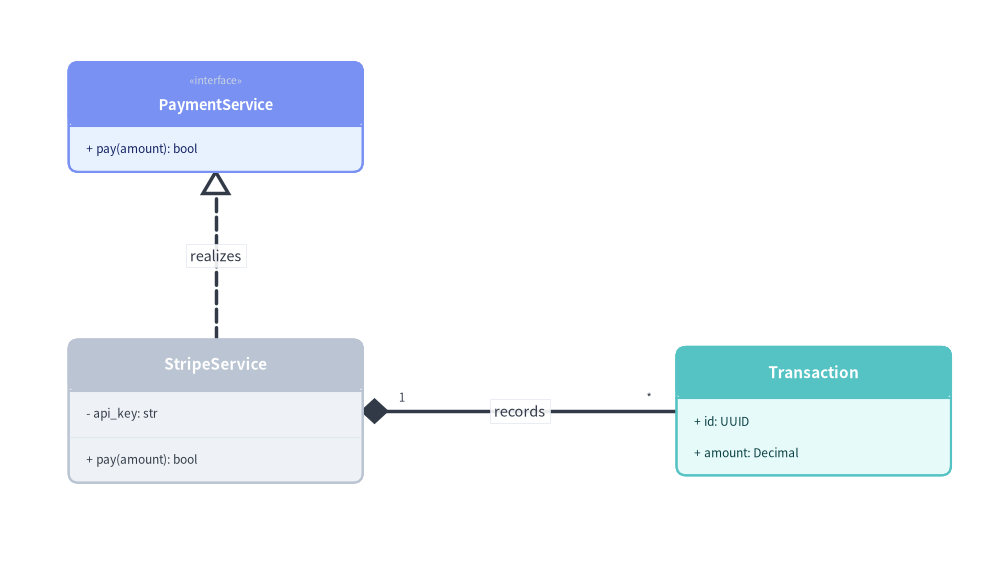
ClassDiagram implements standard UML 2.0 Object-Oriented structural modeling. It features three-compartment class cards (class name, attributes, methods), stereotypes, abstract classes, and all 6 standard UML relationships.
1. Overview & Three-Compartment Cards
Source Code
from drawlib.canvas import save, setup
from drawlib.diagrams.class_diagram import ClassDiagram, ClassNode
from drawlib.styles import Styles

setup(width=102, height=58)

cd = ClassDiagram(
    node_style=Styles.Neutral,
    edge_style=Styles.DarkBold,
    edge_text_style=Styles.Dark.patch(text_size=10.5),
)

payment_svc = cd.add(
    ClassNode(name="PaymentService", stereotype="interface", width=30.0, style=Styles.PrimaryNeutral),
    xy=(20.0, 44.0),
)
payment_svc.add_method("pay", params="amount", return_type="bool")

stripe_svc = cd.add(
    ClassNode(name="StripeService", width=30.0, style=Styles.Neutral),
    xy=(20.0, 14.0),
)
stripe_svc.add_attribute("api_key", type="str", is_public=False)
stripe_svc.add_method("pay", params="amount", return_type="bool")

tx = cd.add(
    ClassNode(name="Transaction", width=28.0, style=Styles.SecondaryNeutral),
    xy=(81.0, 14.0),
)
tx.add_attribute("id", type="UUID", is_public=True)
tx.add_attribute("amount", type="Decimal", is_public=True)

cd.connect(
    stripe_svc,
    payment_svc,
    relationship_type="realization",
    start_side="top",
    end_side="bottom",
    label="realizes",
)
cd.connect(
    stripe_svc,
    tx,
    relationship_type="composition",
    start_side="right",
    end_side="left",
    start_multiplicity="1",
    end_multiplicity="*",
    label="records",
)

cd.draw(xy=(2.0, 2.0))
save()
- Three Compartments: Class cards automatically separate the class title/stereotype header, attribute declarations, and method signatures into distinct compartments with divider lines.
- Access Modifiers: Supports standard UML visibility prefixes:
+(public),-(private),#(protected),~(package). - Dynamic Sizing: The card height automatically expands (
node.effective_height) to accommodate all attributes and methods.
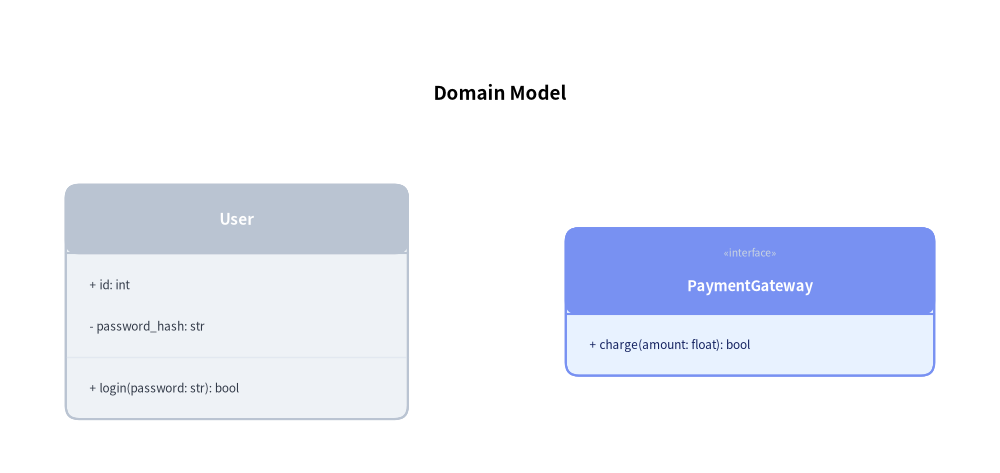
2. Constructor, ClassNode & Member Declarations
from drawlib.canvas import save, setup
from drawlib.diagrams.class_diagram import ClassDiagram, ClassNode
from drawlib.styles import Styles

setup(width=76, height=36)

cd = ClassDiagram(
    node_style=Styles.Neutral,
    edge_style=Styles.DarkBold,
    edge_text_style=Styles.Dark.patch(text_size=10.5),
    title="Domain Model",
    title_style=Styles.BlackBold.patch(text_size=13.5),
)

# Class with attributes and methods
user = cd.add(ClassNode(name="User", width=26.0), xy=(18.0, 13.0))
user.add_attribute("id", type="int", is_public=True)
user.add_attribute("password_hash", type="str", is_public=False)
user.add_method("login", params="password: str", return_type="bool")

# Interface with stereotype
gateway = cd.add(
    ClassNode(name="PaymentGateway", stereotype="interface", width=28.0, style=Styles.PrimaryNeutral),
    xy=(57.0, 13.0),
)
gateway.add_method("charge", params="amount: float", return_type="bool")

cd.draw(xy=(0.0, 0.0))
save()
Parameter Reference Tables
ClassDiagram Class
| Parameter | Type | Default | Description |
|---|---|---|---|
node_style |
Style |
(Required) | Base Style object for class cards in the diagram. |
edge_style |
Style |
(Required) | Base Style object for relationship lines and UML markers. |
edge_text_style |
Style |
(Required) | Base Style object for relationship labels, roles, and multiplicities. |
title |
str |
"" |
Optional title displayed above the diagram. |
title_style |
Style | None |
None |
Optional Style object for the diagram title. |
style |
Style | None |
None |
Optional Style overriding the overall diagram background. |
width |
float | None |
None |
Optional fixed canvas width (auto-calculated from content if None). |
height |
float | None |
None |
Optional fixed canvas height (auto-calculated from content if None). |
margin |
float |
5.0 |
Outer margin padding surrounding all classes when auto-calculating size. |
header_style |
Style | None |
None |
Optional Style overriding class card header compartments across the diagram. |
ClassNode Class
| Parameter | Type | Default | Description |
|---|---|---|---|
name |
str |
(Required) | Class or interface name. |
stereotype |
str |
"" |
Optional UML stereotype rendered as «stereotype» (e.g. "interface", "abstract", "enumeration"). |
is_abstract |
bool |
False |
When True, renders the class name in italic font. |
width |
float |
28.0 |
Width of the class card in canvas units. |
height |
float | None |
None |
Optional minimum height override (auto-expands to fit attributes/methods if None or smaller). |
size |
tuple[float, float] | None |
None |
Optional (width, height) shorthand tuple overriding width and height. |
header_height |
float | None |
None |
Height of the header compartment (6.5 when stereotype is set, otherwise 5.2). |
row_height |
float |
3.2 |
Vertical height of each attribute and method line. |
style |
Style | None |
None |
Optional Style override for the card border and body fill. |
header_style |
Style | None |
None |
Optional Style override for this card's header compartment background and text. |
show |
bool |
True |
Visibility flag (connected ClassRelationship edges auto-hide when False). |
Attribute & Method Declaration API (AttributeInfo & MethodInfo)
from drawlib.diagrams.class_diagram import AttributeInfo, MethodInfo

# Single attribute & batch attributes
node.add_attribute(
    name: str,
    type: str = "",
    is_public: bool = True,
    visibility: str | None = None,      # "+", "-", "#", or "~" (overrides is_public if set)
    default_value: str = "",            # Rendered as " = <default_value>"
    is_static: bool = False,
) -> ClassNode

node.add_attributes(
    attributes: Sequence[Sequence[Any] | AttributeInfo],
    # Each tuple is (name, [type, is_public, visibility, default_value]) or an AttributeInfo instance
) -> ClassNode

# Single method & batch methods
node.add_method(
    name: str,
    params: str = "",
    return_type: str = "",
    is_public: bool = True,
    visibility: str | None = None,      # "+", "-", "#", or "~" (overrides is_public if set)
    is_static: bool = False,
    is_abstract: bool = False,
) -> ClassNode

node.add_methods(
    methods: Sequence[Sequence[Any] | MethodInfo],
    # Each tuple is (name, [return_type, params, is_public, visibility]) or a MethodInfo instance
) -> ClassNode
3. The 6 UML Relationship Types (ClassRelationship)
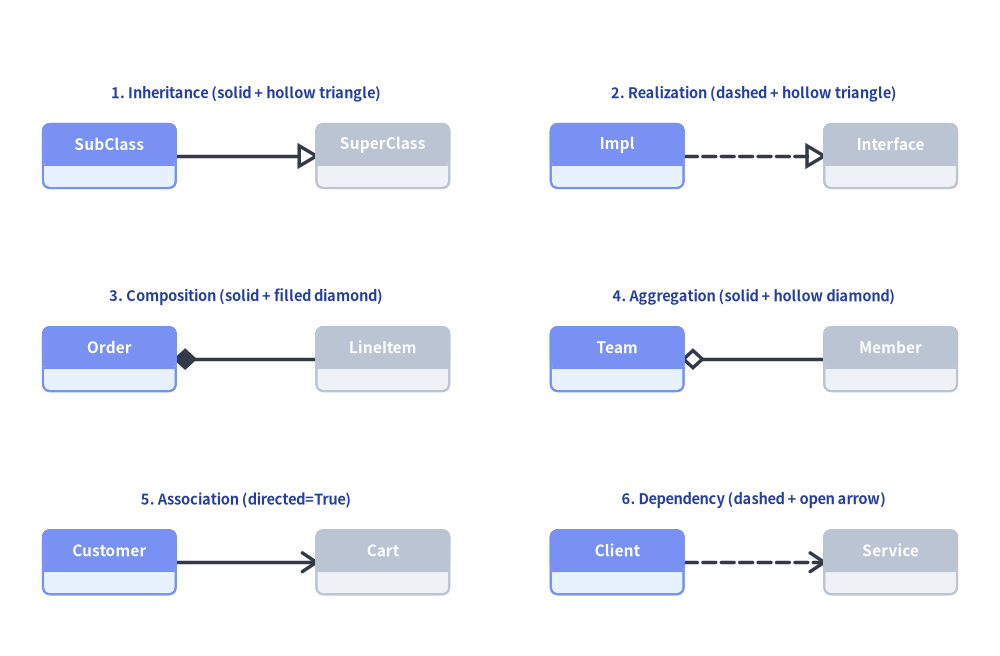
Relationships between classes are registered at the diagram level via cd.connect(source, target, relationship_type=...) (or cd.add_relationship(rel: ClassRelationship) -> ClassRelationship):
relationship_type |
Shorthand Alias | Relationship | Line Stroke | Marker | Semantic Meaning |
|---|---|---|---|---|---|
"inheritance" |
"inherit" |
Inheritance | Solid | Hollow Triangle (at target) |
Superclass generalization |
"realization" |
"realize" |
Realization | Dashed | Hollow Triangle (at target) |
Interface implementation |
"composition" |
"composite" |
Composition | Solid | Filled Diamond (at source) |
Strong lifecycle ownership |
"aggregation" |
"aggregate" |
Aggregation | Solid | Hollow Diamond (at source) |
Shared lifecycle / part-whole |
"association" |
"associate" |
Association | Solid | None (or Open Arrow if directed=True) |
Structural reference |
"dependency" |
"depend" |
Dependency | Dashed | Open Arrow (at target) |
Uses-a dependency |
from drawlib.canvas import save, setup
from drawlib.diagrams.class_diagram import ClassDiagram, ClassNode
from drawlib.styles import Colors, Styles
from drawlib.text import text

setup(width=128, height=84)

cd = ClassDiagram(
    node_style=Styles.Neutral,
    edge_style=Styles.DarkBold,
    edge_text_style=Styles.Dark.patch(text_size=10.5),
)

# 2x3 Grid of the 6 UML Relationship Types
specs = [
    # Left column (x_src=14, x_dst=49)
    ("1. Inheritance (solid + hollow triangle)", "inheritance", False, 14.0, 49.0, 64.0, "SubClass", "SuperClass"),
    ("3. Composition (solid + filled diamond)", "composition", False, 14.0, 49.0, 38.0, "Order", "LineItem"),
    ("5. Association (directed=True)", "association", True, 14.0, 49.0, 12.0, "Customer", "Cart"),
    # Right column (x_src=79, x_dst=114)
    ("2. Realization (dashed + hollow triangle)", "realization", False, 79.0, 114.0, 64.0, "Impl", "Interface"),
    ("4. Aggregation (solid + hollow diamond)", "aggregation", False, 79.0, 114.0, 38.0, "Team", "Member"),
    ("6. Dependency (dashed + open arrow)", "dependency", False, 79.0, 114.0, 12.0, "Client", "Service"),
]

lbl_style = Styles.DarkBold.patch(text_size=10.5, text_color=Colors.Primary5)

for _title_str, rel_type, is_dir, x1, x2, y, src_name, dst_name in specs:
    n_src = cd.add(ClassNode(name=src_name, width=17.0, style=Styles.PrimaryNeutral), xy=(x1, y))
    n_dst = cd.add(ClassNode(name=dst_name, width=17.0, style=Styles.Neutral), xy=(x2, y))
    cd.connect(
        n_src,
        n_dst,
        relationship_type=rel_type,
        directed=is_dir,
        start_side="right",
        end_side="left",
    )

cd.draw(xy=(0.0, 0.0))

for title_str, _rel_type, _is_dir, x1, x2, y, _src_name, _dst_name in specs:
    text(((x1 + x2) / 2.0, y + 8.0), title_str, style=lbl_style)

save()
cd.connect(...) Signature
cd.connect(
    source: ClassNode,
    target: ClassNode,
    relationship_type: RelationshipType = "association",
    *,
    type: RelationshipType | None = None,              # Keyword alias for relationship_type
    label: str = "",
    start_side: Literal["left", "right", "top", "bottom", "auto"] = "auto",
    end_side: Literal["left", "right", "top", "bottom", "auto"] = "auto",
    start_multiplicity: str = "",                      # e.g. "1", "0..1"
    end_multiplicity: str = "",                        # e.g. "*", "1..*"
    start_role: str = "",
    end_role: str = "",
    directed: bool = False,                            # Draws open navigability arrow at target
    style: Style | None = None,
    text_style: Style | None = None,
    routing: Literal["orthogonal", "direct"] = "orthogonal",
    padding: float | tuple[float, float] = 0.0,
    show: bool = True,
) -> ClassRelationship
Registration, Sizing & Rendering Lifecycle
cd.add(class_node, xy=(cx, cy), show: bool | None = None) -> ClassNode: Registers a class card centered at(cx, cy)and returns the mutableClassNode(node.show,node.style,node.header_style). Hiding a class (show=False) also automatically hides allClassRelationshipedges connected to it while keeping diagram bounds fixed.cd.get_bounds() -> tuple[float, float, float, float]: Returns(min_x, min_y, max_x, max_y)enclosing all registered classes.cd.get_size() -> tuple[float, float]: Returns(width, height)of the diagram (includingmargin).cd.draw(xy=(0.0, 0.0), *, scale: float = 1.0) -> None: Renders the class diagram anchored at bottom-leftxy, proportionally scaling card widths, compartment heights, UML markers, and typography byscale.
4. E-Commerce Domain Model
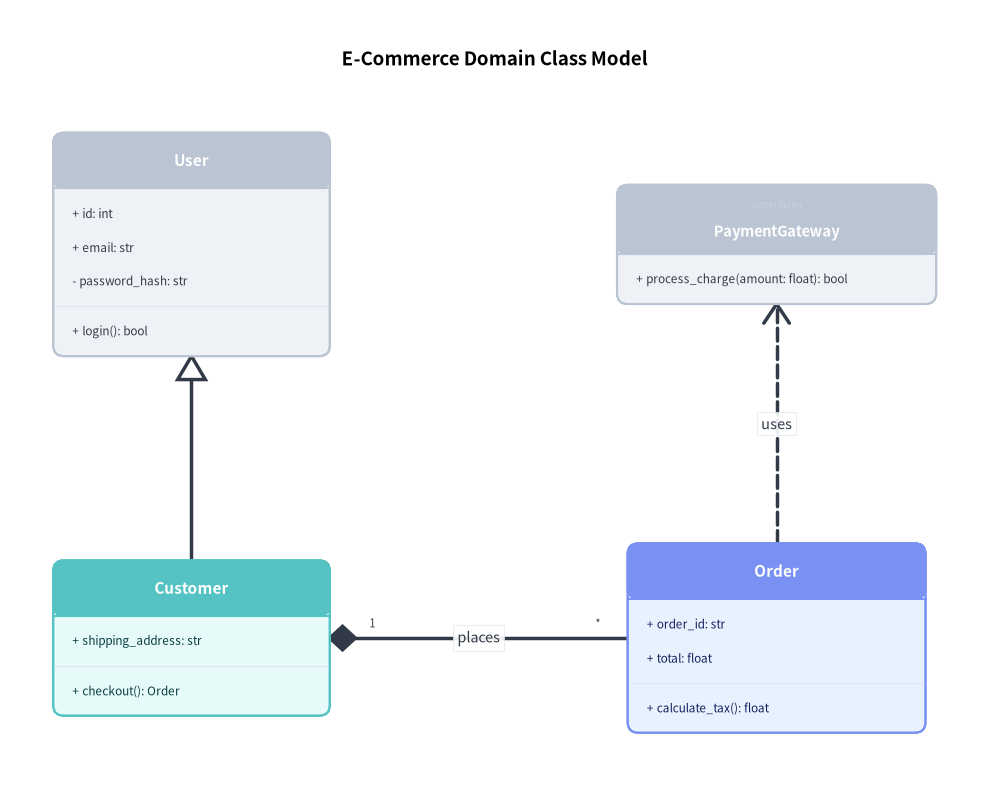
The following example combines inheritance, composition, and interface dependency:
from drawlib.canvas import save, setup
from drawlib.diagrams.class_diagram import ClassDiagram, ClassNode
from drawlib.styles import Styles

setup(width=94, height=74)

cd = ClassDiagram(
    node_style=Styles.Neutral,
    edge_style=Styles.DarkBold,
    edge_text_style=Styles.Dark.patch(text_size=10.5),
    title="E-Commerce Domain Class Model",
    title_style=Styles.BlackBold.patch(text_size=13.5),
)

# 1. Define classes
user = cd.add(ClassNode(name="User", width=26.0), xy=(18.0, 51.0))
user.add_attribute("id", type="int", is_public=True)
user.add_attribute("email", type="str", is_public=True)
user.add_attribute("password_hash", type="str", is_public=False)
user.add_method("login", return_type="bool")

customer = cd.add(ClassNode(name="Customer", width=26.0, style=Styles.SecondaryNeutral), xy=(18.0, 14.0))
customer.add_attribute("shipping_address", type="str")
customer.add_method("checkout", return_type="Order")

order = cd.add(ClassNode(name="Order", width=28.0, style=Styles.PrimaryNeutral), xy=(73.0, 14.0))
order.add_attribute("order_id", type="str")
order.add_attribute("total", type="float")
order.add_method("calculate_tax", return_type="float")

iface = cd.add(ClassNode(name="PaymentGateway", stereotype="interface", width=30.0), xy=(73.0, 51.0))
iface.add_method("process_charge", params="amount: float", return_type="bool")

# 2. Connect relationships using diagram.connect
cd.connect(customer, user, "inheritance", start_side="top", end_side="bottom")
cd.connect(
    customer,
    order,
    "composition",
    start_side="right",
    end_side="left",
    start_multiplicity="1",
    end_multiplicity="*",
    label="places",
)
cd.connect(order, iface, "dependency", start_side="top", end_side="bottom", label="uses")

cd.draw(xy=(0.0, 0.0))
save()
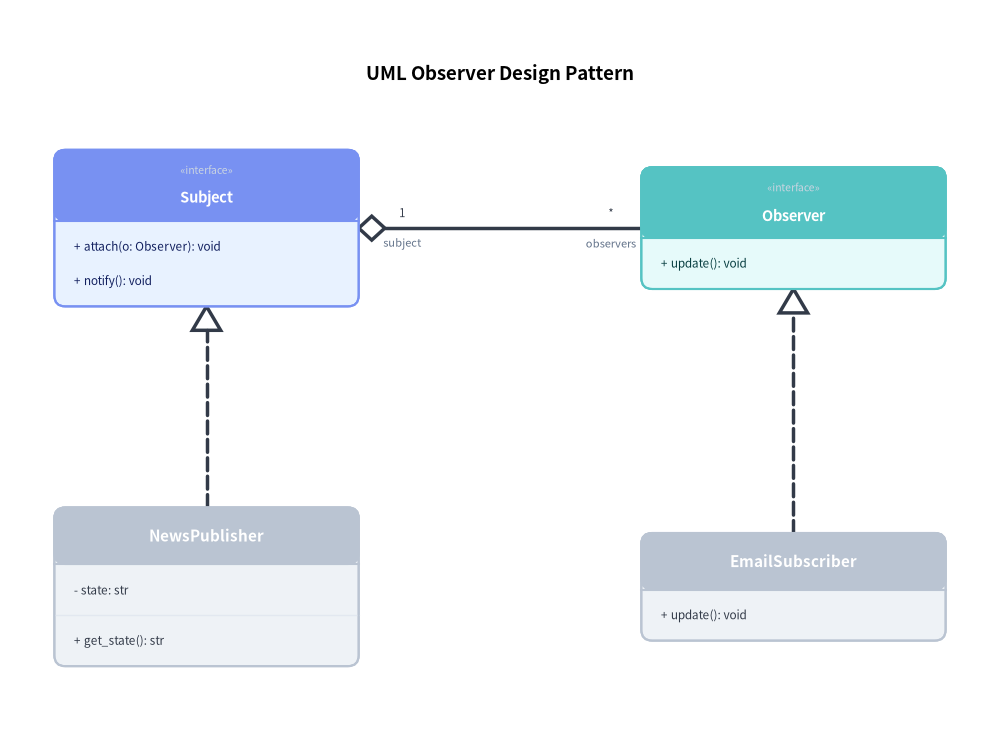
5. Design Pattern Modeling: Observer Pattern
Class diagrams excel at illustrating software design patterns such as the Observer pattern:
from drawlib.canvas import save, setup
from drawlib.diagrams.class_diagram import ClassDiagram, ClassNode
from drawlib.styles import Styles

setup(width=92, height=68)

cd = ClassDiagram(
    node_style=Styles.Neutral,
    edge_style=Styles.DarkBold,
    edge_text_style=Styles.Dark.patch(text_size=10.5),
    title="UML Observer Design Pattern",
    title_style=Styles.BlackBold.patch(text_size=13.5),
)

subj_iface = cd.add(
    ClassNode(name="Subject", stereotype="interface", width=28.0, style=Styles.PrimaryNeutral),
    xy=(19.0, 47.0),
)
subj_iface.add_method("attach", params="o: Observer", return_type="void")
subj_iface.add_method("notify", return_type="void")

obs_iface = cd.add(
    ClassNode(name="Observer", stereotype="interface", width=28.0, style=Styles.SecondaryNeutral),
    xy=(73.0, 47.0),
)
obs_iface.add_method("update", return_type="void")

concrete_subj = cd.add(ClassNode(name="NewsPublisher", width=28.0), xy=(19.0, 14.0))
concrete_subj.add_attribute("state", type="str", is_public=False)
concrete_subj.add_method("get_state", return_type="str")

concrete_obs = cd.add(ClassNode(name="EmailSubscriber", width=28.0), xy=(73.0, 14.0))
concrete_obs.add_method("update", return_type="void")

cd.connect(concrete_subj, subj_iface, "realization", start_side="top", end_side="bottom")
cd.connect(concrete_obs, obs_iface, "realization", start_side="top", end_side="bottom")
cd.connect(
    subj_iface,
    obs_iface,
    "aggregation",
    start_side="right",
    end_side="left",
    start_multiplicity="1",
    end_multiplicity="*",
    start_role="subject",
    end_role="observers",
)

cd.draw(xy=(0.0, 0.0))
save()
6. Best Practices & Guidelines
- Card Width Sizing: Choose a consistent card width (
26.0to30.0units) across horizontally aligned classes to maintain visual balance. - Explicit Connection Sides: Specifying
start_sideandend_sideensures orthogonal lines route cleanly around cards without cutting through text compartments.